
Emerging Adults’ Identities, Attitudes, and Orientations Concerning Non-Monogamy.
 I was a member of the Interactive Measurement Group for two years, from Spring 2015 to Fall 2016. I recently finished my Masters in Communication Studies at UNLV, producing a master’s thesis as my culminating experience. My involvement in the Interactive Measurement Group provided significant preparation for graduate-level work and my thesis project. Through participating in workshops and projects as a lab member, I entered graduate school very familiar with designing surveys using Qualtrics and using SONA to recruit participants from the university student pool and grant them credit afterwards. Additionally, I was prepared to clean and analyze data, and communicate my findings using an academic writing style I developed during my undergraduate research experience.
Here is a summary of my thesis research.
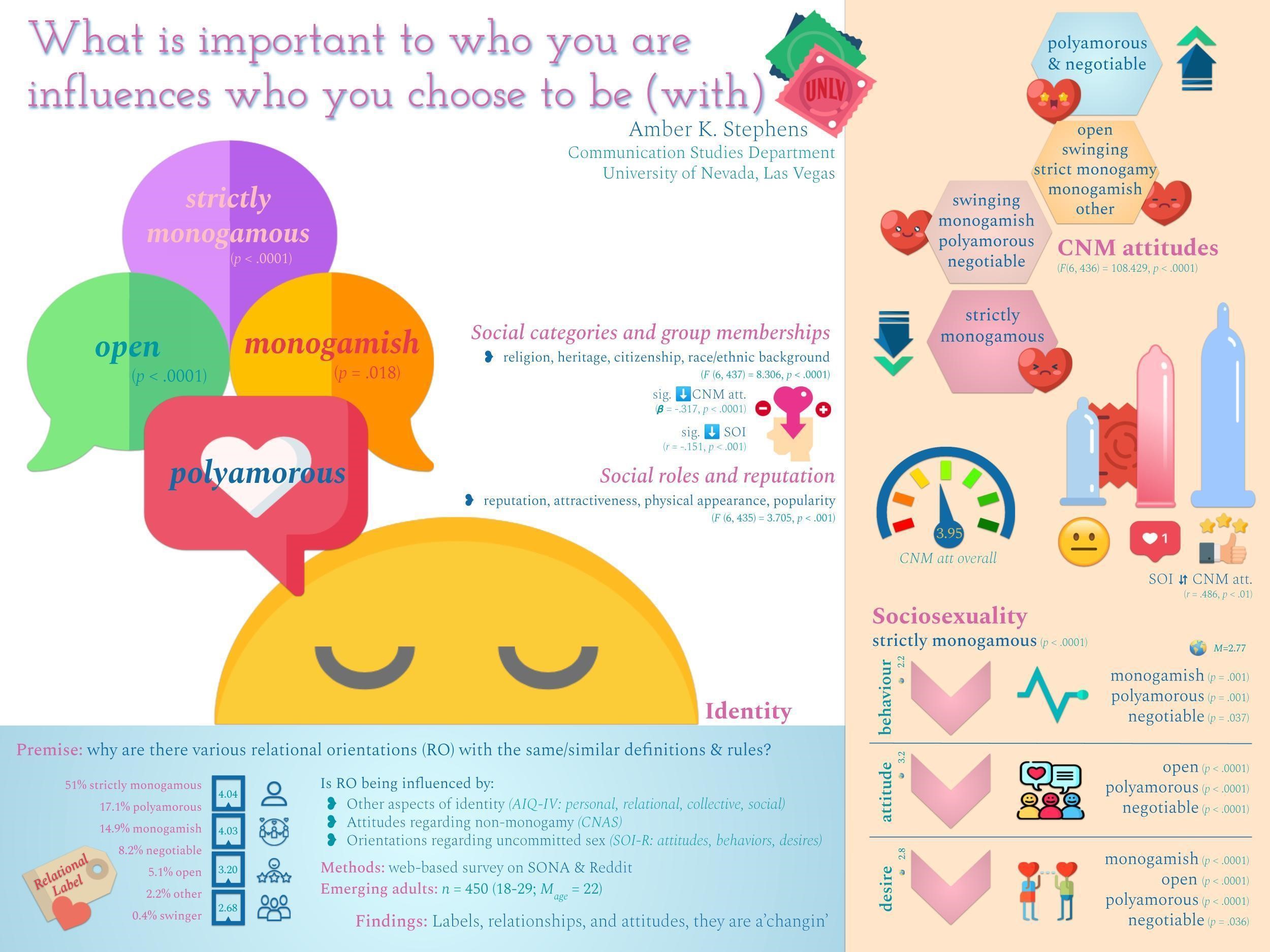
Today’s emerging adults (ages 18-29) are customizing their relationships to fulfill specific desires, needs, and goals in manners perhaps considered to be nontraditional in days past (Barker, 2011; Barker & Langdridge, 2010). Non-monogamy is an umbrella term that covers a variety of relationship configurations – including open, swinging, and polyamory – in which individuals have negotiated the allowance of emotional/sexual connections with multiple partners (Barker & Langdridge, 2010; Cohen & Wilson, 2017; Pitagora, 2016). The purpose of my master’s thesis was to explore the association among identity, relational labeling, and orientations toward uncommitted sex and non-monogamy to better understand why various relational labels were being used to distinguish between non-monogamous practices that have similar/overlapping definitions, behaviors, and rules. Specifically, is relational orientation influenced by (1) other aspects of the individual’s identity (personal, relational, social, collective), (2) their attitudes regarding non-monogamy, and (3) their general orientations regarding uncommitted sex (sociosexual attitudes, behaviors, desires). These research questions were built on self-identity research suggesting that social interactions and behaviors are influenced by how individuals define themselves in relation to others (Johnson, 2018), as well as findings indicating that emerging adults today are participating in and exposed to diverse sexual and relational practices.
Data were collected online from 450 emerging adults (18-29; Mage = 22), who were recruited from Reddit pages and from entry-level communication studies courses at a large diverse university in the southwest. I found that strong identification with social categories and groups (e.g., religion, heritage, citizenship, race/ethnic background; F(6, 437) = 8.31, p < .0001) and social roles and reputation (e.g., reputation, attractiveness, physical appearance, popularity, F(6, 435) = 3.705, p < .001) are related to the way that individuals identify their relational orientation as well as their orientations toward uncommitted sex and non-monogamy. Emerging adults who identify as strictly monogamous, monogamish, and open had significantly stronger connections to collective and social identity aspects compared to those who identify as polyamorous. It makes sense that polyamorous individuals would be less likely to define their sense of self in relation to social status or heritage/community, given that polyamorous individuals have traditionally been marginalized and excluded from social groups (e.g., Jordan, Grogan, Muruthi, & Bermúdez, 2017). Thus, my findings suggest that polyamorous individuals are less influenced by social scaffolding and labeling or, perhaps, are simply rejecting it altogether (e.g., Averett, 2016).
Non-monogamous individuals (i.e., monogamish, open, swinging, and polyamorous) have a more positive orientation toward uncommitted sex and non-monogamy than those who identify as strictly monogamous, supporting previous findings (Klesse, 2018; Mogilski, Memering, Welling, & Shackelford, 2017). Individuals who identify as strictly monogamous have less positive views regarding non-monogamy and indicate fewer sociosexual desires, but some of these individuals do enact the same types of non-monogamous practices as those who label themselves as monogamish.
One’s relational orientation (i.e., strictly monogamous, monogamish, swinging, open, negotiable, and polyamorous) is influenced by the preponderance of one’s social categories/group and social roles/reputation (e.g., religion, heritage, citizenship, race/ethnic background, reputation, attractiveness, physical appearance, popularity). Strictly monogamous, monogamish, and open individuals all have significantly higher associations with these identity facets than polyamorous individuals. However, monogamish and open individuals have similar sociosexual orientations as polyamorous folks, all of whom reported significantly more uncommitted sexual behaviors and desires than strictly monogamous individuals. These data indicate that the extensiveness of one’s associations to social categories/group and social roles/reputation are related to individuals’ decisions to choose a monogamish, open, or new relational orientation to represent their variation of non-monogamy, instead of labeling themselves as polyamorous, even when the behaviors and desires are the same or similar. Additionally, the preponderance of certain social categories, roles, and reputations in one’s identity influence how one chooses to label one’s relational orientation, attitudes toward non-monogamy, and orientation toward uncommitted sex.
Several implications can be drawn from these findings as they relate to identity in the emerging adult population. Because individuals with a collective identity orientation view the social world through the lens of their group members and value the importance of their group membership in their self-concept (Cheek & Briggs, 2013), it is possible that these individuals are responding to the identity items with consideration of their social values/heritages, which are traditionally conservative regarding sexuality and sexual practices (Cheek & Briggs, 2013). Thus, the finding that individuals with strong collective identities hold negative attitudes toward non-monogamy and relational promiscuity makes sense, given that people with a strong connection to religion and family heritage/ tradition also typically value conservative sexual attitudes and norms (e.g., Ahrold, Farmer, Trapnell, & Meston, 2011). These data support Gaertner et al.’s (2012) argument that identity aspects have “motivational potency due to their susceptibility to norms of interdependence, connectedness and the importance of others” (p. 999) and Seta, Seta, and Hundt’s (2001) findings that individuals’ identity orientations can shape their social perceptions.
This study offers foundational insight into the association between identity and how individuals choose to label and represent their relational orientation, particular regarding non-monogamous practices. This is the only study of its kind to consider the associations among identity and relational orientations, sociosexuality, and attitudes. These associations are of importance because, as indicated by the sample data, identity influences the way individuals label their relational orientations, as well as their orientations, behaviors, and attitudes regarding uncommitted sex and sexual engagement. In the current culture, which largely privileges monogamy and heteronormativity (Jordan et al., 2017), it is important to consider how individuals with marginalized identities (such as non-binary, non-heterosexual, and non-monogamous individuals) choose to label and represent themselves, as these individuals face negative stigmatization and backlash (Blumer & VandenBosch, 2015). The topic of non-monogamy is of particular concern, as it is evident that emerging adults today are more open to forms of non-monogamy without any formal/legal recognition or rights. Current research suggests that 54–67% of today’s emerging adults endorse and engage in non-monogamy and that 31% of women and 38% of men indicated that their ideal relationship would involve some variation of non-monogamy (Moore, 2016). With so many individuals openly participating in these various relational orientations, this topic has the potential to become the next moral/legal debate regarding marriage (Dugan, 2017; King & Cronin, 2016) and family (Sheff, 2017), making continued research regarding this issue crucial. A better understanding of how certain role identities, such as one’s relational orientation, are influenced is essential, as we could presently be on the verge of a new frontier of sexual, emotional, and familial relationship practices and communications.
References
Ahrold, T. K., Farmer, M., Trapnell, P. D., & Meston, C. M. (2011). The relationship among sexual attitudes, sexual fantasy, and religiosity. Archives of Sexual Behavior, 40(3), 619-630. https://doi.org/10.1007/s10508-010-9621-4
Arnett, J. J. (2015). The Oxford handbook of emerging adulthood. Oxford: University Press.
Averett, K. (2016). The gender buffet: LGBTQ parents resisting heteronormativity. Gender & Society, 30(2), 189-212. https://doi.org/10.1177/0891243215611370
Barker, M. (2011). Monogamies and non-monogamies: A response to “The challenge of monogamy: Bringing it out of the closet and into the treatment room” by Marianne Brandon. Sexual and Relationship Therapy, 26(3), 281-287. https://doi.org/10.1080/14681994.2011.595401
Barker, M. & Langdridge, D. (2010). Whatever happened to non-monogamies? Critical reflections on recent research and theory. Sexualities, 13(6). 748-772. https://doi.org/10.1177/1363460710384645
Blumer, M. L. C., Hertlein, K. M., & VandenBosch, M. L. (2015). Towards the development of educational core competencies for couple and family therapy technology practices. Contemporary Family Therapy, 37(2), 113-121. https://doi.org/10.1007/s10591-015-9330-1
Cheek, J. M. & Briggs, S. R. (2013). Aspects of Identity Questionnaire (AIQ-IV). Measurement Instrument Database for the Social Science. Retrieved from: chrome-extension://cbnaodkpfinfiipjblikofhlhlcickei/src/pdfviewer/web/viewer.html?file=https://www.midss.org/sites/default/files/aiq.pdf
Cohen, M. T., & Wilson, K. (2017). Development of the Consensual Non-Monogamy Attitude Scale (CNAS). Sexuality & Culture, 21(1), 1-14. https://doi.org/10.1007/s12119-016-9395-5
Dugan, A. (2017). Moral Acceptance of Polygamy at Record High — But Why? Gallup. Retrieved from: https://news.gallup.com/opinion/polling-matters/214601/moral-acceptance-polygamy-record-high-why.aspx
Gaertner, L., Sedikides, C., Luke, M., O’Mara, E. M., Iuzzini, J., Jackson, L. E., Cai., H, & Wu, Q. (2012). A motivational hierarchy within: Primacy of the individual self, relational self, or collective self? Journal of Experimental Social Psychology, 48(5), 997-1013. https://doi.org/10.1016/j.jesp.2012.03.009
Johnson, A. (2018). 7 celebrity couples who have gotten real about open relationships. Insider. Retrieved from: https://www.thisisinsider.com/celebrity-couples-talking-about-open-relationships-2018-5
Jordan, L., Grogan, C., Muruthi, B., & Bermúdez, J. (2017). Polyamory: Experiences of power from without, from within, and in between. Journal of Couple & Relationship Therapy, 16(1), 1-19. https://doi.org/10.1080/15332691.2016.1141135
King, A., & Cronin, A. (2016). Bonds, bridges and ties: Applying social capital theory to LGBT people’s housing concerns later in life. Quality in Ageing and Older Adults, 17(1), 16-25. https://doi.org/10.1108/QAOA-05-2015-0023
Klesse, C. (2018). Theorizing multi-partner relationships and sexualities – Recent work on non-monogamy and polyamory. Sexualities, 21(7) 1109–1124. https://doi.org/10.1177/1363460717701691
Mogilski, J. K., Memering, S. L., Welling, L. L. M., & Shackelford, T. K. (2017). Monogamy versus consensual non-monogamy: Alternative approaches to pursuing a strategically pluralistic mating strategy. Arch Sex Behav, 46, 407–417. https://doi.org/10.1007/s10508-015-0658-2
Moore, P. (2016). Nearly a fifth of under-30s have engaged in sexual activity with someone else, with the knowledge of their partner. YouGov. Retrieved from: https://today.yougov.com/news/2016/10/03/young-americans-less-wedded-monogamy/
Pitagora, D. (2016). The kink-poly confluence: Relationship intersectionality in marginalized communities. Sexual and Relationship Therapy, 31(3), 391-405. https://doi.org/10.1080/14681994.2016.1156081
Seta, J. J., Seta, C. E., & Hundt, G. M. (2001). Exaggerating the differences between relatively successful and unsuccessful groups: Identity orientation as a perceptual lens. Group Dynamics: Theory, Research, and Practice, 5(1), 19–32. https://doi.org/10.1037/1089-2699.5.1.19
Sheff, E. A., (2017). Children in polyamorous families part 1. Psychology Today. Retrieved from: https://www.psychologytoday.com/us/blog/the-polyamorists-next-door/201704/children-in-polyamorous-families-part-1
 Amber Stephens was in the Interactive Measurement Group from January 2015 until January 2017. For graduate school, she continued at UNLV, completing an MA in Communication Studies. She is now applying for research/pedagogy focused jobs in industry and higher education. She plans to complete a Ph.D. in the future.